Luxury Panel Systems USA: Architectural & Engineering Guide
The contemporary building envelope requires an integrated approach to environmental control, structural load distribution, and long-term durability. Specifiers, architects, and engineers face the task of integrating high-performance materials, thermal-break connections, and airtight structural connections into the core envelope and interior partitions of commercial and multi-residential spaces. Luxury Panel Systems USA. This approach balances uninterrupted interior acoustics and structural stability with strict life-cycle energy standards.
The design of architectural wall cladding goes beyond basic compliance with local energy or building codes. Heavy panels act as thermal, acoustic, and environmental filters that must minimize thermal bridging and air infiltration while accommodating significant building movement and dynamic wind loads. Achieving these conditions requires close collaboration among structural engineers, material scientists, and specialist millworkers.
To ensure long-term performance and financial control, project teams must analyze physical constraints and structural loading histories. This comprehensive reference document explores the engineering mechanics, system variations, testing methodologies, and economic variables that govern modern architectural paneling. By examining the physical behavior of building systems, this guide provides a systematic methodology for evaluating and understanding the best systems available across various climate zones and building typologies.
Introduction
High-performance architecture requires an integrated approach to building envelope and interior space design. The wall panel must function as a thermal break, an acoustic dampening barrier, and a structural component capable of resisting dynamic loads. Specifying the correct materials ensures that the building skin remains resilient across various climates and use cases.
The interaction between the outer cladding, the internal drainage cavity, and the structural backup wall dictates the lifespan of the building asset. Understanding these dynamics is central to modern architectural design. Without careful attention to the interfaces between components, the entire assembly risks premature failure, regardless of how durable the individual exterior panels are.
This guide provides a detailed look at the engineering principles, material science, and economic realities of modern facade and interior paneling. By analyzing various material choices and system makeups, architects and engineers can choose assemblies that meet structural, environmental, and aesthetic performance goals.
Understanding Luxury Panel Systems USA
When design professionals and building envelope consultants investigate the market for luxury panel systems usa, designers and engineers must view the cladding as an integrated thermodynamic and structural system rather than a collection of decorative boards or composite skins. The primary objective is to design an envelope or interior assembly that maximizes thermal resistance, manages moisture, and controls acoustic transfer without relying on unnecessary material weight or complex, high-maintenance field connections.
A common pitfall in modern design is the assumption that applying thick natural wood or heavy stone veneers will automatically solve condensation and structural support problems. In practice, selecting a non-ventilated or poorly broken sub-frame assembly can trap humidity behind the panel, leading to structural degradation and premature finish breakdown.
To ensure long-term performance, design and construction teams must look past the visual rendering and analyze the physics of the system. Unlike traditional load-bearing partitions, modern panel systems rely on mechanical sub-frames and dynamic movement tolerances. Any design oversight, anchor deflection, or installation flaw can lead to premature degradation of the water-resistive barrier and internal framing.
Deep Contextual Background: System Evolution
The development of exterior and interior panel envelopes in North America evolved from early-twentieth-century solid masonry and heavy-timber raised paneling to the thin, non-load-bearing architectural elements that define contemporary city skylines. The widespread use of structural steel and reinforced concrete frames early in the twentieth century allowed exterior walls to become non-structural screens, transferring their dead load and wind loads back to the primary framework.
The post-war building boom saw the rise of modern curtain walls and exterior cladding. Early designs, however, were plagued by thermal bridging and water infiltration issues due to improper expansion allowances and rudimentary sealants. Throughout the 1970s and 1980s, the industry shifted toward performance-based facade design. Engineers introduced pressure-equalized rainscreen principles and structural silicone glazing to the market, allowing the exterior skin to resist dynamic pressures while remaining weathertight.
In the twenty-first century, the evolution of high-strength structural extrusions and composite materials has turned the exterior and interior panel into a highly engineered, active component of the building. The development of unitized rainscreen systems allowed for off-site fabrication, improving quality control and increasing installation speed.
Conceptual Frameworks and Design Models Luxury Panel Systems USA
To analyze the structural and thermodynamic performance of an exterior or interior panel installation, engineers rely on specific mental models and analytical frameworks:
-
The Pressure-Equalized Rainscreen Model: This model treats the outer cladding as a shield that deflects driving rain. It requires the designer to size the ventilation openings and internal compartmentalization correctly so that the air pressure inside the cavity matches the external wind pressure, preventing capillary action from pulling water into the backup wall.
-
The Continuous Thermal Bridge Matrix: This model evaluates the flow of heat through the entire wall assembly, including fasteners, clips, and spandrel beams. It optimizes the balance between structural support and thermal resistance, ensuring that interior surface temperatures stay above the dew point in harsh winter conditions.
-
The Dynamic Hygrothermal Analysis Framework: This framework simulates the coupled transport of heat and moisture through the wall’s joinery over an annual weather cycle, assessing the risk of internal condensation.
Technical Classifications and System Variations Luxury Panel Systems USA
To select the most appropriate system, designers compare variations based on their structural support mechanisms, material composition, and intended application in high-performance construction.
Comparison of Architectural Panel Systems
| System Variation | Assembly Makeup | Structural Characteristics | Best Use Cases | Trade-Offs |
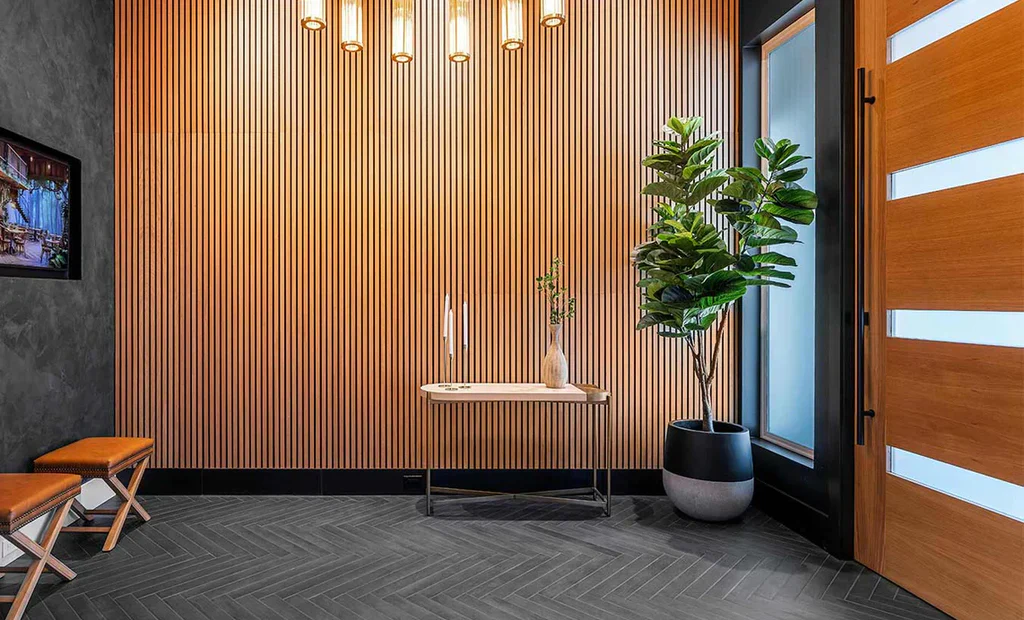
| Acoustic Slat Wood Panels | Wood veneer on felt or composite backing | High sound absorption and warm aesthetic | Home studios, media rooms, corporate offices | Sensitivity to moisture if not properly sealed |
| Terracotta Rainscreen Panels | Fired clay modules with integrated clips | Non-combustible, very high longevity, natural finish | University buildings, institutional facades | High dead load requiring strong support sub-frames |
| Aluminium Honeycomb Panels | Thin aluminium skins bonded to an aluminum honeycomb core | Extremely high strength-to-weight ratio, flatness | Premium high-rise spandrels, dynamic canopies | High material cost, requires edge-sealing |
| Glass-Fiber Reinforced Concrete | Cement matrix reinforced with alkali-resistant fibers | Thin profile, flexible three-dimensional shapes | Curved building skins, lightweight spandrel covers | Requires precise installation, energy-intensive curing |
| Cerused and Smoked Oak Panels | Wire-brushed oak on multi-layer substrate | Artisanal appearance with high structural stability | High-end executive suites, custom millwork | High cost, prone to scratching under heavy use |
| Phenolic Compact Laminate Panels | Resin-impregnated paper cores under high pressure | Extreme impact resistance and chemical resistance | Hospitals, educational facilities, public transport | Heavy, requires specialized sub-frame anchoring |
| Bio-based Composite Panels | Plant fibers and bio-resins with woodgrain texture | Low embodied carbon, good acoustic performance | Sustainable multi-family lobbies, retail | Limited moisture and exterior weathering capacity |
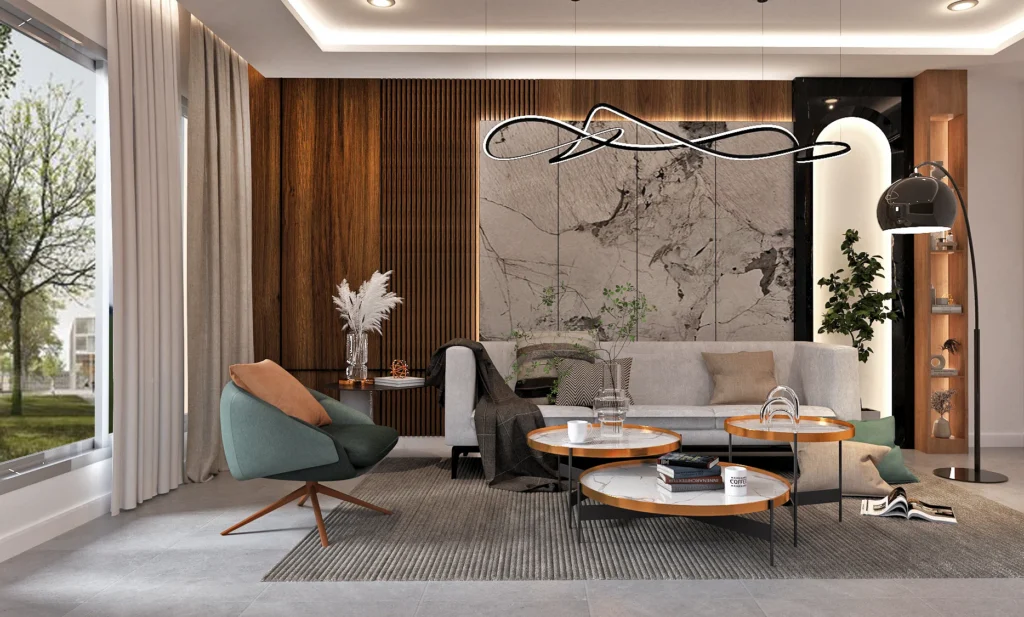
System selection requires a rigorous analysis of environmental and structural loads. For example, an engineer designing a high-capacity facade in a high-wind coastal zone would specify a heavy-gauge aluminum honeycomb system. In contrast, for an urban retail development or residential living room requiring acoustic treatment, an acoustic slat wood panel is often the more suitable alternative.
Real-World Application Scenarios Luxury Panel Systems USA
The practical execution of panel engineering plans depends on local constraints, climatic exposures, and structural geometries.
Scenario A: The Multi-Story Corporate Lobby
An urban high-rise office building requires a continuous, character-rich interior lobby skin with high acoustic damping and narrow joint sightlines. The design must resist impact loads in a high-density environment while meeting the acoustic performance requirements for open spaces.
-
Decision Point: Choosing between a natural stone panel system and an acoustic wood slat panel system.
-
Analysis of Options:
-
Option 1 (Natural Stone): Provides an ultra-high-end, monolithic appearance, but creates high reverberant noise and adds considerable weight to the wall studs.
-
Option 2 (Acoustic Wood Slat System): Dampens lobby echo, meets current acoustic guidelines, and is lighter and easier to install with hidden Z-clips.
-
-
Second-Order Effect: The reduced structural weight eliminates the need to reinforce the internal structural steel studs, lowering installation costs.
Scenario B: The Coastal Educational Facility
A facility near the ocean must resist high salt-fog exposure and severe wind-driven rain. The design must prevent corrosion of the support clips and water infiltration into the structural sheathing.
-
Decision Point: Specifying standard steel framing clips versus high-grade marine-alloy stainless steel clips with isolators.
-
Analysis of Options:
-
Option 1 (Standard Steel Clips): Lower upfront cost but prone to rapid galvanic corrosion and failure in a marine environment, leading to panel detachment.
-
Option 2 (Stainless Steel Clips with Isolators): Higher upfront cost but eliminates the risk of corrosion and forms a thermal break between the sub-frame and the backup wall.
-
-
Failure Mode: Selecting standard-grade fasteners can create galvanic reactions with aluminum or metal extrusions, causing cross-threaded failures and loss of holding strength under load.
Scenario C: The Freeze-Thaw Prone Institutional Building
An institutional building located in a northern climate with wide temperature swings requires an exterior skin that remains stable during repeated freeze-thaw cycles without cracking or seal failure.
-
Decision Point: Selecting a traditional adhered stone system versus an advanced terracotta rainscreen system.
-
Analysis of Options:
-
Option 1 (Adhered Stone): Allows cold temperatures to transfer directly to the interior frame, causing condensation and interior finish damage.
-
Option 2 (Terracotta Rainscreen): Keeps the interior surface temperature of the framing above the dew point, preventing condensation and reducing heating loads.
-
-
Compounding Risk: Improper drainage detailing at the base of the wall can trap water inside the sill, leading to mold growth and ice expansion within the assembly.
Scenario D: The Complex Geometry Civic Center
A public performing arts center features a curved facade with asymmetrical configurations, requiring dynamic panel layouts and tight movement joints.
-
Decision Point: Choosing a standard unitized module system versus a custom bio-composite or glass-fiber reinforced panel facade.
-
Analysis of Options:
-
Option 1 (Standard Unitized Modules): Difficult to adapt to highly non-planar surfaces without creating large variations in the joint widths or requiring custom dies.
-
Option 2 (Glass-Fiber Reinforced Concrete): Allows for three-dimensional geometry and irregular spans while maintaining a seamless and monolithic architectural profile.
-
-
Design Consideration: The added weight of the custom GRC panels requires structural modifications to the building’s primary steel frame and foundation connections.
Planning, Cost, and Resource Dynamics
The financial framework of panel systems is sensitive to the design, procurement, and fabrication processes. Overspecification or late changes to panel dimensions often lead to significant cost premiums without measurable improvements in performance.
Estimated Cost Variance by Assembly Type
| Category | Typical Cost Range per Sq Ft | Primary Cost Drivers |
| Acoustic Slat Wood Panels | $25 – $65 | Veneer selection, felt density, custom milling |
| Terracotta Rainscreen Panels | $65 – $140 | Kiln processing, sub-frame clips, corner transitions |
| Aluminium Honeycomb Panels | $85 – $170 | Manufacturing scale, panel curvature, fire testing |
| Glass-Fiber Reinforced Concrete | $55 – $115 | Casting methods, mold preparation, handling weight |
| Wire-Brushed Cerused Wood Panels | $75 – $150 | Artisan finishing processes, multi-layer substrate |
| Phenolic Compact Laminate Panels | $40 – $95 | Fire-retardant core treatments, CNC routing |
Opportunity costs are prevalent in this market. Choosing large-format architectural panels often requires specialized hoisting equipment and longer lead times for custom coatings. Furthermore, if the shop drawings are not coordinated with the structural steel or concrete frame, the resulting dimensional adjustments can delay the entire construction schedule.
Tools, Strategies, and Support Systems Luxury Panel Systems USA
To design with the best systems, specifiers use several analytical and testing platforms:
-
Finite Element Analysis (FEA) Software: Programs model the stress concentrations around anchors and calculate the deflection of complex panel systems under dynamic wind loads.
-
THERM and WINDOW Software: Used to calculate two-dimensional heat transfer through frame sections, ensuring the long-term thermal safety of the wall.
-
Thermographic Cameras: Used during building audits to identify structural thermal bridges and areas with poor insulation coverage.
-
Acoustic Testing Facilities: Used to verify the sound transmission class rating of the wall assembly in lively open-plan environments.
-
Wind-Tunnel Testing: Physical models tested in boundary-layer wind tunnels to determine localized peak pressures on complex exterior installations.
-
Full-Scale Structural Mock-Ups: A 1:1 scale test of the connection details, panel joints, and air barrier makeups to confirm the performance of the system before mass production.
-
Water Penetration Testing Chambers: Used on-site according to AAMA and ASTM standards to ensure that the installed wall assembly does not leak during severe weather events.
The Risk Landscape: Structural Vulnerabilities and Failure Modes
Understanding the risk landscape and identifying the compounding failure modes is critical to specifying luxury panel systems USA installations accurately.
-
Anchor Corrosion and Failure: The loss of load-bearing capacity due to galvanic corrosion, oxidation, or improper anchor embedment into the backup wall.
-
Delamination: The separation of the outer skin from the core material in composite panels, often caused by poor manufacturing quality or moisture intrusion along the edges.
-
Air Barrier Puncture: Damage to the water-resistive barrier during the installation of sub-framing clips, leading to moisture infiltration into the cavity.
-
Thermal Bridging at Fasteners: Excessive heat loss through metallic clips and fasteners, which lowers the overall effective R-value of the wall and causes interior condensation.
Governance, Maintenance, and Long-Term Adaptation Luxury Panel Systems USA
Panel systems require an active maintenance program to achieve their target lifespan of 30 to 50 years.
The Layered Maintenance Checklist
-
Bi-Annually: Wash the exterior surfaces and inspect the perimeter joints for signs of sealant cracking or separation.
-
Every Five Years: Perform a detailed pull-test or inspection of the structural anchors and check for signs of sub-frame corrosion.
-
Replacement Triggers: Replace any panel that shows signs of seal failure, fogging, or delamination, which indicates a loss of structural integrity.
-
Documentation and Records: The facility manager must maintain a digital log of the makeup, batch number, and installation location of every panel on the facade.
Measurement, Tracking, and Evaluation
Assessing the performance of an exterior cladding system requires both quantitative and qualitative methods:
-
Leading Indicators: Real-time data from strain gauges attached to the support brackets, measuring deflection and stress during high-wind events.
-
Lagging Indicators: The frequency of panel repair or an increase in the building’s energy consumption due to air and moisture leakage.
-
Documentation Examples:
-
Digital Twins: A model tracking every architectural panel, its material properties, and its location on the structure.
-
Calibration Reports: Records verifying the anchor torque applied to all support connections during assembly.
-
As-Built Dimensional Surveys: Measurements comparing the structural frame to the panel fabrication tolerances.
-
Common Misconceptions and Oversimplifications
-
Myth: All architectural panels are non-combustible.
-
Correction: Some composite panels include a backing core that can propagate fire if not specified with a fire-retardant formulation.
-
-
Myth: Rainscreens prevent all moisture from entering the wall assembly.
-
Correction: Rainscreens are designed to let water enter and exit; they manage moisture through drainage and ventilation rather than absolute sealing.
-
-
Myth: Adding continuous exterior insulation solves all thermal bridging problems.
-
Correction: Fasteners and structural clips can still act as thermal bridges unless isolated with non-metallic thermal break pads.
-
-
Myth: All wood wall panels behave the same under high humidity.
-
Correction: Solid wood panels are more prone to warping than engineered composite substrates and require strict indoor relative humidity controls.
-
-
Myth: Sealant joints last the life of the building.
-
Correction: Sealants experience UV degradation and require replacement every 10 to 15 years.
-
-
Myth: Architectural panel construction cannot be used as a structural, low-carbon material.
-
Correction: Solid timber and structural bio-based panels can reduce embodied carbon significantly compared to standard aluminum and concrete systems.
-
Ethical and Contextual Considerations
The specification of exterior and interior panel assemblies involves significant sustainability and ethical responsibilities. The production of metal panels, cementitious boards, and insulation materials generates substantial embodied carbon. Engineers and designers should balance the desire for durability with the need for low energy consumption over the building’s lifecycle.
Furthermore, transparent and glossy building elements present a significant hazard to migratory bird populations. Ethical design considerations require the integration of fritted patterns, acid-etched designs, or ultraviolet-reflective coatings that make the glass and facade elements visible to birds without compromising the performance of the building envelope.
Synthesis and Editorial Perspective
The creation and execution of architectural panel plans require technical discipline, attention to detail, and intellectual honesty. A high-performance exterior wall or interior wall assembly is a composite system that must be engineered to withstand the effects of wind, thermal expansion, and mechanical loads.
As we continue to push the boundaries of energy efficiency in modern architecture, the safety and performance of these systems will depend on our ability to manage the material’s properties.